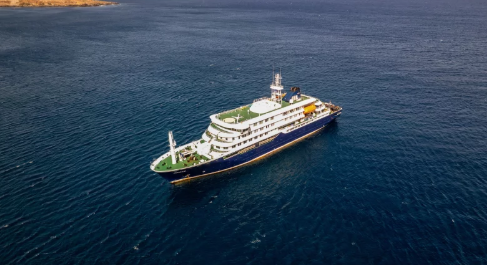
On April 1st, 2026, a cruise ship called the MV Hondius set out to sea from Argentina to sail the South Atlantic for a birdwatching and wildlife spotting journey on some of the most remote islands in the world. Unexpectedly, a Dutch passenger died aboard the ship 10 days later.
Leo Schilperood fell ill on April 6th and died five days later on the 11th after receiving intensive care in the sick bay of the cruise. Passengers didn’t suspect anything about a virus. Jan Dobrogowski, captain of the cruise said,“Tragic as it is, due to natural causes, we believe,” during his announcement on April 12th to the rest of the ship after the passenger’s death, explaining that the believed cause of Leo’s death was natural causes. Mirjam Schilperood-Huisman, Leo’s wife, was asked if she would like the trip cut short after the discovery of her husband’s passing. In response, she said no, explaining that “everyone is here for a purpose,” and she urged fellow birdwatchers to continue on because her husband “would have wanted me to do the same.” Two weeks later, however, Mirjam was also found dead.
Mirjam Schilperood-Huisman began feeling very sick around April 16 and the surrounding days. New York Times says, “She held tight to the ship’s railings and accepted help from other passengers, whom she called ‘my protective angels.’” From April 22nd to 24th at the island of St. Helena, 30 people disembarked the cruise, including Mirjam. She was planning to fly to Johannesburg with her husband’s remains on her way home to the Netherlands. After boarding the plane in a wheelchair, she appeared to become sicker, and Dutch flight attendants tended to her for nearly an hour. According to the woman who stood behind Mirjam in the boarding line said, “The crew helped her, without any protection against a virus, and then they served everyone on board snacks and drinks.” The flight crew decided she was too sick to travel past Johannesburg, therefore she was taken to an ambulance clinic in the area, where she died on April 26.
After some investigation, health officials declared that the cause of the couple’s death was almost certainly the Andes species of Hantavirus, a virus that was first discovered in the US in 1933 but wasn’t a big deal until now. It is actually a series of viruses that is carried by rodents and spread by humans. The Schilperood couple that passed away had been having a very successful birdwatching trip aboard the cruise. One sight that many cruise passengers visited for birdwatching was a landfill area that attracted many unique species of birds. Some speculation online suggested that this area is what caused the two to become infected by Hantavirus, but there was no evidence that the couple even visited this spot.
Because the MV Hondius traveled to so many different places and had passengers from all around the world, the spread of Hantavirus is inevitable. Near the end of its journey, the cruise was headed to Tenerife in the Canary Islands, however many of the leaders from the area asked that the cruise did not travel there in fear that the virus could spread to them. “Rats might swim ashore and bring the virus to them.” As of Friday, May 15th, the World Health Organization (W.H.O), said that at least ten cases of hantavirus have been traced back to the ship, 8 of which have been confirmed, while 2 were just suspected. On Saturday, May 2nd, a German woman who spent time with the infected Dutch couple died on the ship. Both her and the doctor aboard got hantavirus, and she was unfortunately unable to survive it. It is estimated that at least 2 of the cruise deaths, but probably all 3, were attributed to the virus.
When the MV Hondius reached its destination, Cape Verde, passengers were not allowed to immediately leave the ship, causing some panic among the passengers. Those who were on the cruise had to be safely evacuated in a specific way to keep the virus as contained as possible and to stop it from spreading too much. The 18 Americans aboard returned to the US on Monday, May 11th, and were immediately transported to a quarantine facility at the University of Nebraska Medical Center. Jake Rosmarin, a travel influencer from Boston, was among them. Throughout his time during quarantine, which is a 42-day-long period, he has given a tour of his room and made frequent updates on his experiences. Those in quarantine are monitored every day to ensure they do not show any symptoms of having the hantavirus. According to NPR, “U.S. health officials say it takes prolonged contact with someone who is showing symptoms to spread the virus. Minimizing contact with those who may have been exposed is meant to stop any unprotected interactions that could lead to the possible spread of hantavirus.” Those in quarantine will eventually be given the opportunity to do at-home quarantine where they will still be monitored and will have to report back on their health, but they are encouraged to stay in the facility for extra safety measures.
Cites –
https://www.nytimes.com/2026/05/16/world/europe/hantavirus-hondius-cruise.html
https://www.health.harvard.edu/immune-and-infectious-diseases/hantavirus-explained-what-to-know-after-the-cruise-ship-outbreak
https://www.npr.org/2026/05/15/nx-s1-5819872/hantavirus-quarantine
https://www.npr.org/2026/05/08/nx-s1-5811917/hantavirus-andres-mvhondius-ship-rodents